Get to Know Ahsha Safaí and Mark Farrell, the Mayoral Candidates Who Have Earned the Dual-Endorsement of the SF Building Trades Council
Interviews by Robert Fulton | contributing writer
It’s a tough call being asked to choose between multiple strong candidates when you cast your ballot in any election, let alone in one that’s been as hyped as the City’s upcoming mayoral race. Hitting the polls in a municipality that offers ranked-choice voting, however, makes a tough call less tough, since voters can stack their ballots with all of their favored candidates in the top slots. (Deciding what order to put them in is another story.)
'That’s how San Francisco votes. This relatively new ranked-choice ballot system has, in turn, spurred the San Francisco Building and Construction Trades Council’s first-ever dual-endorsement for mayor.
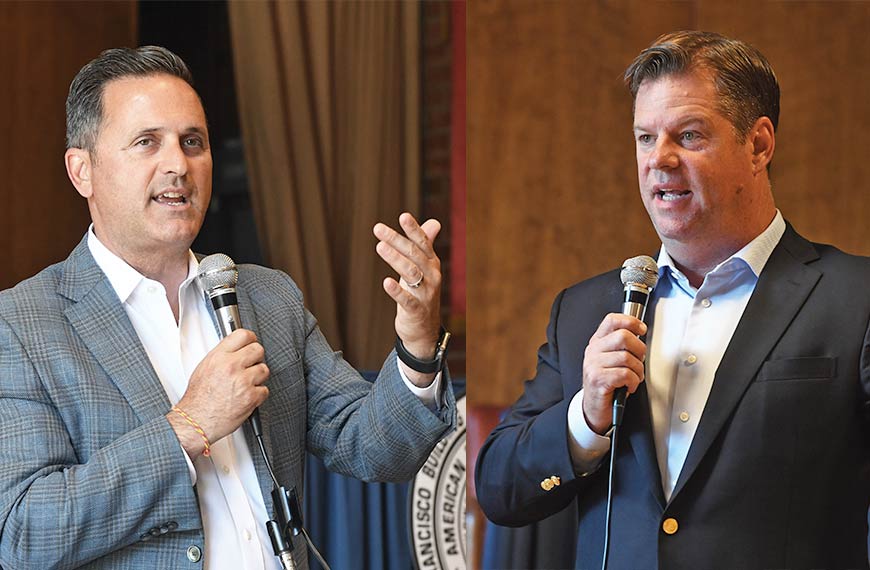
District 11 Supervisor Ahsha Safaí and former SF Mayor Mark Farrell, two prime contenders among the field of five candidates, have both won the nod from the council.
The two men are running against each other and everyone else in the race, of course, but a near-equal set of pro-union and building-trades-friendly bona fides make Safaí and Farrell especially well-positioned to root out the City’s persistent issues and lead San Franciscans into a brighter future, according to the council.
Our reporter set out to learn what makes these two candidates tick — and not just politically, but personally, too. He returned with a pair of straight-shooting Q&A-style interviews, one with Safaí and one with Farrell. In this edition of Organized Labor, we present those interviews to you so that you can assess these two candidates for yourself and decide who you want to slot in at No.1 and at No. 2 on your ranked-choice ballot for mayor this year.
We hope this helps make your call even less tough.
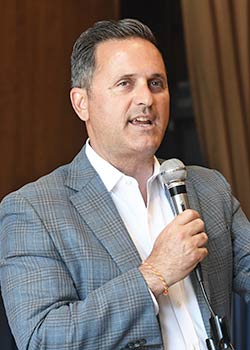
Ahsha Safaí
Age: 51
Born: Iran, raised in Massachusetts
Current residence: Excelsior District
Family life: Married, two children
Professions: Political director at SEIU Local 87 (San Francisco’s janitors’ union), principal at Kitchen Cabinet Public Affairs
Public service: Served on the SF Board of Supervisors, District 11, from 2017 to present; worked under mayors Willie Brown and Gavin Newsom with the SF Housing Authority, the Mayor’s Office of Community Development, and the SF Department of Public Works
San Francisco District 11 Supervisor Ahsha Safai’s route to running for SF mayor took a few turns before landing him here, now, as a candidate. Born in Iran, he and his mother moved to Cambridge, MA, when he was 5 years old. He earned a master’s degree in city planning from the Massachusetts Institute of Technology before heading out west for San Francisco 24 years ago.
Safaí shared several highlights of recent legislation and spoke about what losing a supervisorial election in 2008 taught him.
This interview has been edited and condensed for clarity.
Organized Labor: What’s your vision for the role of mayor of San Francisco?
Ahsha Safaí: At the end of the day, we need a city that’s for all San Franciscans. I’m running to represent working- and middle-class families, not just the rich. This is a city that has been turned upside-down by wealth, and we have to make sure that you don’t have to be rich to live here — that working- and middle-class families can live here as well. That’s my vision for San Francisco. Whether we’re talking about creating housing for working families; or creating accessible, affordable childcare; or continuing and supporting free city college — all of the things that working middle-class families can really benefit from — that’s what I have fought for and will continue to fight for.
OL: What’s your approach to construction in San Francisco?
AS: We just passed legislation that will lower the transfer tax on properties that use pension-fund money for investment. There are over 40,000 units in the pipeline that are waiting to get unstuck, and they need additional financing. So, if we can put union members to work with their own money using pension fund dollars to generate growth and jump-start the economy, all while reducing the transfer tax and inviting more pension fund investment, I think it’ll make a significant impact on putting union people to work.
I’ve always pushed and advocated for the philosophy that if union members build it, they should be able to live in it. Unfortunately, for so much of what they build and maintain in this city, they’re forced to travel from far outside of San Francisco to even be able to work on it. They should be able to live in the city where they work. That’s why I supported the Citywide Project Labor Agreement. I was the leader of that, and we were able to get that passed.
OL: What other achievements or pieces of legislation are you most proud of during your time in office?
AS: The Citywide PLA was something that was started by Mark Farrell when he was a supervisor, and he handed it off to me when he became interim mayor in 2018. That PLA has been a really big benefit to working people on city projects. It also created pathways, using CityBuild, to get more people involved in the trades.
Increasing the inclusionary number when our economy was really strong to create more on-site affordable housing — I led that effort. Right when I was elected in 2017, I worked on and led the effort to get the Student Success Fund created. That creates grants of up to $1 million per school for public schools, allowing them to have things that many of them can’t afford because they don’t have robust PTAs. So, this is a game-changer and an equalizer for public schools.
OL: How did the experience of losing the 2008 election affect you?
AS: At the end of the day, not winning allowed me to go to work for organized labor. I worked with the labor movement. I worked with the janitors as their political director. I did a lot of work with the teamsters and with the laborers. We fought on the front lines for free city college and to save SF City College when it was in the dire position of being shut down. So much of that time has informed the work that I do now on the Board of Supervisors. Much of the work that I’ve approached — whether it’s environmental legislation or it’s legislation for housing construction, or whether it’s something that’s about good government or school support — on every piece of legislation, I worked with organized labor. That includes United Educators, the building trades, janitors, UFCW, and laborers. Every step of the way, everything that I’ve done has been about looking at things through the lens of working families.
OL: Not counting the SF Building Trades, what endorsement have you earned so far that you’re most proud of?
AS: Obviously, I come from the janitor’s union, so I carry a lot of pride in that. I don’t ever take anything for granted. In my prior elections — in 2008; 2016, even; and in 2020 — I never received an endorsement from the United Educators. And this time around, I was very proud to earn their endorsement in my run for mayor. I’m also proud to have spent a lot of time working with them over the past four years. I think we’ve really grown to respect one another and the work we’re all doing.
OL: There’s a lot of vacant office space in San Francisco. What are your plans to address that issue?
AS: I put forward legislation recently, which was passed, to create a public university downtown fund so that we can raise public dollars to go out and purchase some buildings and can convert them, in partnership with some public universities, into downtown campuses. Having more students live, study, and thrive in downtown San Francisco and helping downtown become a more 24-hour environment, I think, is an important thing. We’ve done legislation to better facilitate office-to-residential conversion. It’s part of the reason why the transfer tax is so important.
We want people to occupy, move into, and transform downtown, but we have to really make it clean and safe first. That’s where we are. So, we have to start with the basics. But definitely having a university vision and downtown campus is one goal. Making it clean and safe, with foot patrols, bike patrols, and officers present, is also important.
OL: As mayor, how will you hold people accountable, including yourself? What does accountability mean to you?
AS: Accountability is one of the major job descriptions of mayor. It’s one of the things that’s missing right now. It’s one of the reasons why we’re in this current state as a city — because the mayor’s not fulfilling that part of her job description. From the beginning to the end, her administration has been rotten to the core, and a lot of that stems from how she sets the tone at the top.
OL: Is there any San Francisco icon — an athlete, a politician, anybody that you look up to — who inspires you?
AS: I mean, there are a lot of people. A lot of them are just everyday San Franciscans who get up and do their work. I have a lot of respect for hardworking men and women. As District 11 supervisor, I represent the highest concentration of working families among all of San Francisco’s supervisorial districts. So, whether they’re transit operators from Muni, or janitors, or workers in the construction industry, they’re the people who get up and make the City tick every day. To be honest with you, it’s the hard-working ones who are often forgotten and overlooked. Those are really the people who inspire me more than anyone else.
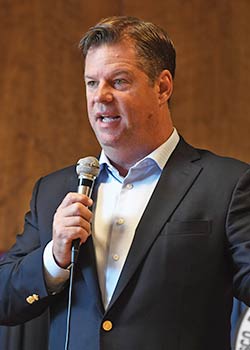
Mark Farrell
Age: 50
Born: San Francisco
Current residence: Jordan Park, near Laurel Village
Family life: Married, three children
Professions: Attorney, investment banker, venture capitalist, former mayor of San Francisco
Public service: Served on the SF Board of Supervisors representing District 2 from January 2011 to January 2018; chaired the City’s Budget and Finance Committee; served as interim SF mayor from January 2018 to July 2018 following the death of Ed Lee
Before he embarked on his bid to be 46th mayor of San Francisco, Mark Farrell was its 44th, having served as interim mayor after the untimely passing of Ed Lee. Following his stint out of the bullpen and two terms as supervisor of District 2, Farrell returned to the private sector, in part to slow the pace of life so that he could spend more time raising his three children in the city where he was also born and raised.
He shared his vision for San Francisco, discussed creating construction jobs, and spoke candidly about his return to politics.
This interview has been edited and condensed for clarity.
Organized Labor: What is your vision for the role of mayor of San Francisco?
Mark Farrell: The mayor of San Francisco is a recognizable figure around the world for one of the most iconic cities in the world, and it is so important that the residents of our city elect someone who will represent everybody in the City. I’m running for mayor because I believe I can combine my seven and a half years of experience inside of City Hall with my 20-plus years in the private sector to hit the ground running on day one.
I believe experience matters. I also believe a track record of success matters. That’s where this current mayor has completely failed the city of San Francisco and our residents. I want to bring back public safety, clean up our streets, bring back a vibrant economy, get the members of our trades working once again, and move our city forward.
OL: You were interim mayor for a brief period. What did you take away from that experience that you could apply in the future?
MF: How powerful the position of mayor of San Francisco is. Mayor Breed uses every excuse in the book to try and explain away why she can’t get anything done inside of City Hall, but in my experience, that office is incredibly powerful. Mayor Breed has failed to use it effectively, and that’s why I believe change is needed to move San Francisco forward.
OL: Why run for mayor now as opposed to back then?
MF: I left City Hall in 2018 because of my children. I am a father first. At the time, our kids were 5, 10, and 12 years old. I simply love coaching their sports teams, traveling with them when we can, and being really engaged in their schools and their daily lives. I don’t regret a single second of the last five years focusing on my career outside of City Hall, but in particular, my family.
I’m running for mayor this year because of my kids again. Our daughter is our oldest, and she’s now in college in Boston. I want her to be proud to call San Francisco home, more than anything. I want her to move back to San Francisco when she graduates. But that means our city has to change. It has to become safe once again. There have to be jobs and economic opportunities for young grads, and our city has to be affordable, too.
OL: What are one or two things that you’re most proud of having accomplished during your time in elected office?
MF: No. 1 is having a core focus and success around public safety and street conditions. During my time in office as budget chair and when I became mayor, we grew our police department to record staffing levels. In my six months as mayor, I took out all of the large tent encampments on our streets and the drug crisis simply wasn’t what it is today.
No. 2 is my relationship with and continued progress with labor inside of City Hall. I grew up as an only child, and both of my parents were not only members of labor unions, but heads of their labor unions. So, for me, as I think about the building and construction trades, I think about other unions here in San Francisco. To me, this is not political — this is personal.
The Citywide Project Labor Agreement that I authored while mayor proves my ability and willingness to partner with labor. I’m proud of that, and I look forward to working on more legislation like it to make sure that San Francisco continues to be a strong union town.
OL: What’s your approach to construction in the City?
MF: The lack of cranes in the air and people at work is a true problem. It’s another output of Mayor Breed’s failed leadership in City Hall to get our economy going — people don’t want to invest in San Francisco right now. We need to be incredibly proactive with our developer community. When we have 35,000 units entitled in City Hall but people aren’t breaking ground, there’s a problem.
We have to work with developers proactively and get them to break ground to ensure that they’re using union labor here in San Francisco. We need to get people working once again and get people developing and investing in San Francisco once again. We need a mayor who is not only engaged with our developer community and with our construction community — someone who really asks them what it’s going to take to break ground — but someone who also focuses on the core issues around public safety and street conditions so that when developers look at buildings and people look to invest, they can see reasonable returns here in the City once again.
OL: There’s plenty of empty office space. How do you plan on tackling that issue?
MF: I believe conversion from commercial to residential is a big part of our future, but in this area in particular, we also have to think outside the box. Right now, people are talking about the 10 buildings downtown that have the right floor plates and light wells to convert. I think we need to be bigger and bolder. We should look at these class-B and class-C buildings right now that are contributing no value to downtown and SoMa and allow them to demo. Then, we need to massively up-zone these parts of San Francisco and commit to tax abatement vehicles for developers so that these projects actually pencil out today.
That way, we can get people back to work and start really building for the future. There’s just no way all of the existing office space is going to get subsumed in the near future.
OL: How do you go about creating more housing that’s affordable for everyone?
MF: We have to build more housing, period. We’re under the mandate to build approximately 10,000 units a year, and last year, we built just 2,000 units. It looks like this year, we’ll build 400. We are failing every step of the way as a city government, so much so that the state is allowing developers to utilize builder’s remedy, with density and zoning allowances, which I think is going to create unintended consequences and outcomes in our neighborhoods.
I want to exceed our goals here locally so that we get the state off our backs. When we do that, we can lower the cost of housing for everybody. If you build it, you should be able to live in it as well.
OL: Why should a member of the building trades vote for you?
MF: There will be no bigger and more effective supporter of our building and construction trades members than me. I want to get people back to work doing sustainable jobs in sustainable careers and livelihoods in San Francisco. I’ll fight to grow our economy in a proactive manner like our city has never seen. With that will come opportunities, careers, and sustained living for our trades members. I look forward to partnering with them.