By Robert Fulton | contributing writer
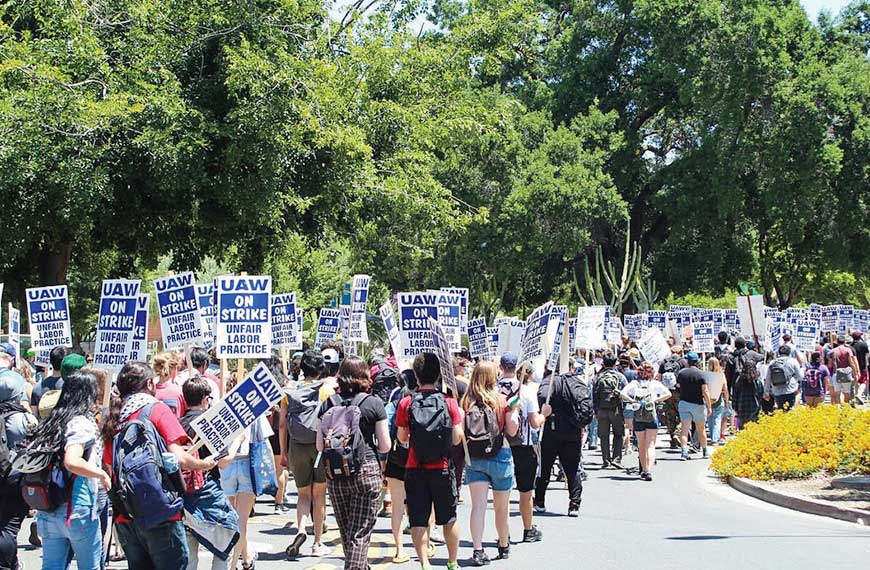
A recent bill in the California State Legislature that would have allowed striking California workers to collect unemployment insurance (UI) benefits has been killed — by Democrats. The bill met its demise in an assembly committee last month apparently due to perceptions about recent University of California worker strikes and protests against Israel’s war on Hamas in Gaza.
California Senate Bill 1116, introduced by Senator Anthony Portantino of Burbank and co-authored by Senator Maria Elena Durazo of Los Angeles, would have given striking workers access to their UI benefits once they’d been on strike for two weeks, and would have capped benefits at a certain point. Even with these limitations, SB 1116 would’ve been a godsend for those who have made the difficult — and long-term — decision to request and win sanction to withhold their labor and forego their paychecks in an attempt to achieve better working conditions.
How did this happen? Let’s start with some background.
Why Strikers Deserve UI Benefits
There are numerous reasons to give UI benefits to striking workers.
These benefits provide a small but often desperately needed financial lifeline for food, rent, mortgage, and bills. They help combat the common bully tactic of employers waiting out a strike in an attempt to starve their striking workforce into submission. They help stabilize local economies affected by strikes.
How do we know this? Because granting striking workers their UI benefits is already the law of the land in New York and New Jersey, so we’ve seen the positive outcomes.
To top it off, workers already pay into the state’s UI fund. It’s their money, and they’re entitled to it.
Considering the reasons, you’d think the solidly (and mostly pro-labor) Democratic state lawmakers we’ve elected to represent us here in California — a supposed bastion of liberal, pro-worker policy — would have no trouble passing this legislation.
Well, you’d be wrong.
An identical bill to SB 1116 sailed to Governor Gavin Newsom’s desk last year, but in a short-sighted move, Newsom vetoed it, citing “funding concerns.” The state’s unemployment insurance fund was some $20 billion in the red at the time due to money it borrowed from the federal government to disburse UI funds during the Covid pandemic. But it’s unrealistic to think that extending UI benefits to striking workers would’ve been a frequent enough occurrence to somehow worsen this debt.
This year, SB 1116 enjoyed broad support from labor statewide. The California Labor Federation sponsored the bill.
It should’ve been a slam-dunk. Instead, it got deflated immediately after tipoff.
Global Politics Kill the Bill
It happened after SB 1116 co-author Durazo presented the bill to the Assembly Standing Committee on Insurance during a hearing on Friday, June 26. She outlined all of the good reasons that the bill should sail through the hearing, emphasizing the fact that striking is an economically devastating sacrifice undertaken by workers as a last resort to achieve fair working conditions.
The trouble started when the committee began discussion. That’s when Assemblymember Rebecca Bauer-Kahan of Orinda spoke about a recent strike by the UC’s UAW-represented academic workers. That strike was called primarily to protest the arrests of nonviolent pro-Palestinian demonstrators on campus but also to confront disciplinary actions taken against UC employees engaged in peaceful protest activities, along with other grievances.
Bauer-Kahan, a Democrat who voted for UI benefits last year, appeared to disagree with the legitimacy of the UC strike despite the fact that it was sanctioned by the Cal Labor Fed.
“I no longer understand if we have a shared understanding of what a strike is,” she said. The assemblywoman, who is a granddaughter of Holocaust survivors, emotionally expressed her concerns based on reports of antisemitism on campus during the strikes.
“I cannot support sending unemployment insurance to individuals who will [claim to be on strike due to] working conditions,” said Bauer-Kahan, pulling her support of the bill.
Others on the committee then began to express similar reservations.
Durazo, who is familiar with strikes from her leadership at Unite Here and as head of the L.A. County Federation of Labor, tried to keep the focus on the rights of striking workers.
“A basic premise in the labor movement is being able to go out on strike,” Durazo said to the committee. “This is about those working men and women having the ability to take on these horrible working conditions. That’s what this bill is about.
“We have to stand up for everyone,” she added. “We can’t be pitted against each other.”
In an attempt at compromise, the bill’s authors said they were prepared to amend the legislation to clarify what strikes would be covered.
Bauer-Kahan called the amendments “meaningless,” and the committee rejected them.
SB 1116 died in committee, with only six members voting yes, two voting no, and five abstaining.
CA Union Workers Collectively Punished
Lorena Gonzalez, principal officer of the Cal Labor Fed, responded to the debacle in a statement issued shortly after the bill’s demise, noting that a supermajority of assemblymembers and senators passed an identical bill last year.
“The failure to pass this bill only punishes grocery workers, janitors, hotel housekeepers, and other workers on strike demanding a better life for themselves and their families,” she said in the statement.
SF Building Trades Council Secretary-Treasurer Rudy Gonzealez also expressed frustration at the bill’s failure, pointing out that the striking UC workers would not have qualified for UI benefits anyway because of the brief duration of their strike. (How their strike ended is its own troubling story.)
“I didn’t expect Democrats to oppose benefits that employees have paid into and are rightfully owed,” he said. “I don’t know how you call yourself a Democrat and vote against giving workers their unemployment insurance.”